I was trained by professors who studied directly under Abraham Maslow at Brandeis—but I studied with them at a small public university in rural Georgia: the University of West Georgia.
It was an unlikely place for a revolution in psychology, and that’s what made it magical.
They didn’t just teach psychology. They taught critical psychology—questioning psychology itself.
“Rats and stats,” they’d say—reductionism (shrinking humans down to parts). Then they’d translate: Don’t confuse the lab with life.
“Freudian drives,” they’d add—determinism (you’re just the sum of your past). Translation: You’re not a puppet.
We studied dreams and creativity, existentialism and meaning. Then we studied the standard courses—biological, abnormal, statistics—but never as dogma. Always with the same clarifying question: Does this way of thinking honor the full complexity of being human?
Maslow’s project, as my professors lived it, was to re-humanize psychology—to pull it away from the poles of “it’s all unconscious drives” or “it’s all conditioning,” and toward the living person who chooses, creates, loves, fails, and grows.
And I’m grateful for that lineage.
But from where I sit today—clinically, culturally, and after COVID—I think the next honest step is this:
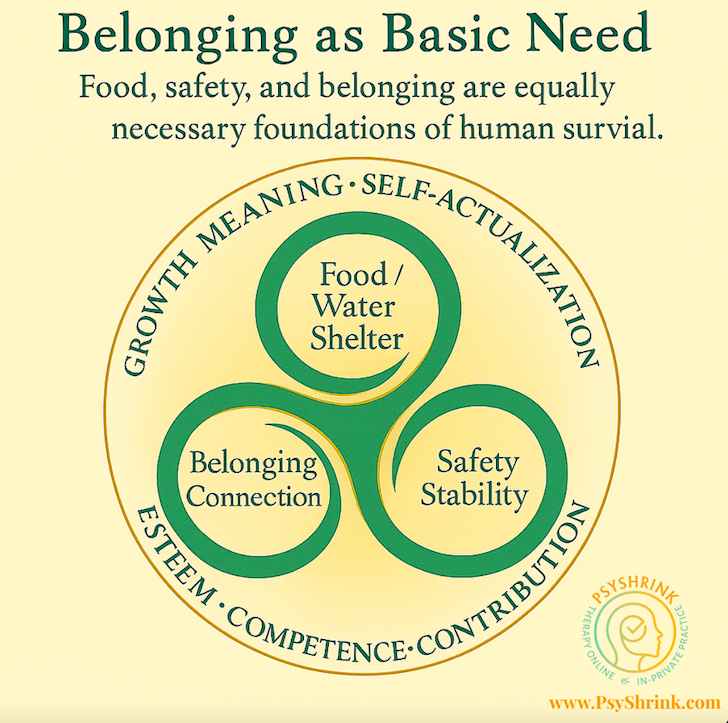
Belonging is not a mid-level luxury. Belonging is a basic need.
Translation: Connection isn’t “later.” It’s “first.”
A quick word on Maslow (for readers who didn’t meet him in Psych 101)
Maslow proposed a hierarchy of needs often drawn as a pyramid.
Bottom: physiological needs—food, water, sleep.
Next: safety—shelter, security, stability.
Then: love/belonging—friendship, intimacy, community.
Above that: esteem and eventually self-actualization—growth, purpose, meaning.
It’s a beautiful, intuitive picture. It also reflects a very individual journey—first I meet my needs, then I connect, then I grow. Elegant. Clean. Linear.
Life, however, is not a triangle. It’s a web.
And humans are not just individuals. We are social animals.
The social animal (thank you, Elliot Aronson)
Social psychologist Elliot Aronson titled his classic book The Social Animal for a reason.
We don’t merely have relationships. We are made in and through them.
• Our identity forms in conversation with others—psychologically and neurologically.
• Our values bend toward the communities we inhabit.
• Our emotions signal social realities—belonging, rejection, status, shame, care.
To put it plainly: even our “self” is a relational project.
Fancy phrase: intersubjectivity. Simple translation: the “me” emerges in the “we.”
If that’s true, then connection can’t be a third-floor add-on. It’s the ground we stand on.
Biology and the pain of isolation
Neuroscience has been quietly telling us this for years:
• Social exclusion lights up brain regions that process physical pain.
Translation: Loneliness hurts in the body.
• Chronic loneliness is linked to poorer health and shorter life.
Translation: Isolation is not just sad; it’s dangerous.
• Infants with food but without affection fail to thrive.
Translation: Touch and attunement are nutrition.
We evolved in tribes where exclusion was life-threatening. Our nervous systems still carry that calculus.
Threat detection isn’t only about tigers and cliffs; it’s also about being left out.
COVID: the natural experiment none of us wanted
The pandemic was the most brutal test of the “belonging comes later” idea.
Many people had food. Many had a roof. “Safety” meant staying home.
If Maslow’s pyramid were a staircase, we should have stood comfortably on the first two steps.
We did not.
Anxiety, depression, and despair surged. Couples frayed. Teenagers retreated or exploded. Elderly adults with everything “basic” in place withered without visitors. Frontline workers risked their lives not just for duty but for fellowship—that bond that makes hardship bearable. People bent rules, not because they were reckless, but because proximity is a basic human nutrient.
Translation: You can’t feel safe while feeling alone.
Safety isn’t only locks on doors; it’s arms around shoulders.
What I see in therapy every week
I work with internationals, professionals, couples, and families. Post-COVID, a pattern keeps repeating:
• “I’m surrounded by messages and DMs, but I feel lonely.”
• “Dating apps feel like Amazon for people—filter, compare, discard.”
• “Where do I even meet someone to just chat?”
• “Why does no one follow through?”
• “Why does everything feel transactional?”
Here’s the clinical truth: when simple, organic conversation is rare—when two humans sitting on a park bench talking about nothing feels like a miracle—we are starving a basic need.
And when a culture starves a basic need, people don’t “under-achieve”; they malfunction. Not because they’re weak—but because they’re wired for connection.
The cultural wrinkle: Western individualism
Maslow wasn’t wrong. He was incomplete—and partly a product of his time and place.
The model is individual-centric—it imagines one person climbing inwardly toward self-actualization.
In many cultures, however, community precedes identity.
Personhood is relational from the start—self-respect rises from mutual respect; growth is a shared project. The village raises the child, and the child knows the village.
When we universalize a Western, individual ladder, we miss what countless traditions know:
We become ourselves inside a network of care.
Fancy word: collectivist. Plain version: We is the starting point.
So what do we change? The shape.
If I could redraw the famous picture, I wouldn’t stack needs into a triangle. I’d plant them like a tree:
• Soil: Belonging. The living medium—family, friends, community, faith, teams, neighborhoods—where nutrients reach every root. Without soil, nothing grows.
Translation: Connection first. Always.
• Roots: Physiological needs and safety. Food, water, sleep; predictability and protection. These needs draw strength from the soil—it’s easier to sleep when you’re not alone; easier to feel safe when someone has your back.
• Trunk: Esteem and competence. We grow upright through recognition and contribution—both are social mirrors.
• Canopy: Self-actualization and meaning. The flowering isn’t a solo act; it shades and seeds the ecosystem. Your growth feeds other lives.
Or, in three plain lines:
Belonging is the medium.
Safety grows in belonging.
Becoming flows from both.
Why this reframing matters (therapy, relationships, work, society)
Therapy.
If belonging is basic, therapy isn’t just insight; it’s re-connection. We work on relationship skills as survival skills—co-regulation, boundaries that protect intimacy, repair after rupture, courage to initiate. Translation: You don’t heal alone.
Relationships.
We must resist the marketplace mindset—the swipe-economy that reduces humans to specs. Replace optimization with attunement (fancy word) / paying close, kind attention (plain words). Replace abundance fantasies with presence. Replace “options” with effort—the boring, beautiful work of showing up.
Workplaces.
Burnout is not only workload; it’s isolation. Psychological safety is not a perk; it’s infrastructure. Teams that narrate reality together—check-ins, debriefs, rituals—perform better because cohesion is a performance enhancer.
Society.
Design cities and policies for gathering: benches that face each other, third places that don’t require purchases, public transport that feels humane, schools that teach collaboration as seriously as calculus.
Translation: Make it easy to bump into each other and talk.
A note to my mentors (and to Maslow)
To the professors at the University of West Georgia who carried Maslow’s flame into a small town and lit the minds of thousands: thank you. You taught me that psychology is born from philosophy—from real questions about being human.
This essay isn’t a takedown; it’s a continuation.
Maslow rescued the person from the machines and the myths. Our task now is to rescue the person from isolation.
The next hierarchy won’t be a ladder we climb alone.
It will be a living system we sustain together.
Practical ways to rebuild belonging (small, doable, today)
• Schedule standing rituals. Same café, same friend, same morning. Routine is relational glue.
• Host micro-gatherings. Three people, one hour, one rule: phones away.
• Practice low-stakes chat. Lines, trains, dog parks. Warm hellos are reps for deeper courage.
• Join a thing. Choir, five-a-side, book club, volunteer shift. Repetition breeds recognition; recognition breeds trust.
• Reach first. Don’t keep score. Initiation is generosity.
• Repair quickly. Short apology. Clear request. Start again.
• Make home “porous.” Invite the neighbor for ten-minute tea.
• Simplify dating. One conversation, one person, one week. Less shopping, more meeting.
• Design for bump-ins. In offices and homes: common tables, visible kitchens, shared breaks.
None of this is glamorous. All of it is medicine.
The line I want you to take with you
We don’t climb toward belonging.
We start there—or we struggle.
If your life feels inexplicably hard right now, consider this possibility:
You are not weak. You are under-connected. And under-connection is a nutritional deficit, not a moral failure.
Feed it like you would any other basic need.
The rest of your life will rise more easily.
What comes next (and why it matters)
I’m writing a follow-up on modern dating—why the swipe economy hijacks our nervous system, how “choice” becomes paradoxical paralysis (fancy phrase) / too many options to choose any, and practical ways to recover organic, human meeting in a digital age.
Because if belonging is basic, then how we seek each other is not trivial. It’s everything.
⸻
If you’re new here
I’m Cynthia, a therapist working with internationals and professionals in Munich and online. I was educated by humanistic psychologists who learned directly from Maslow—and I’m committed to evolving that tradition in a world that needs connection more than ever.
If this resonated, share it with someone you miss.
Or better—send them a time and a place to meet.
Bring back the bench. Bring back the chat. Bring back the we.
Cynthia Kunze, MA
Senior Psychologist at PsyShrink.com