
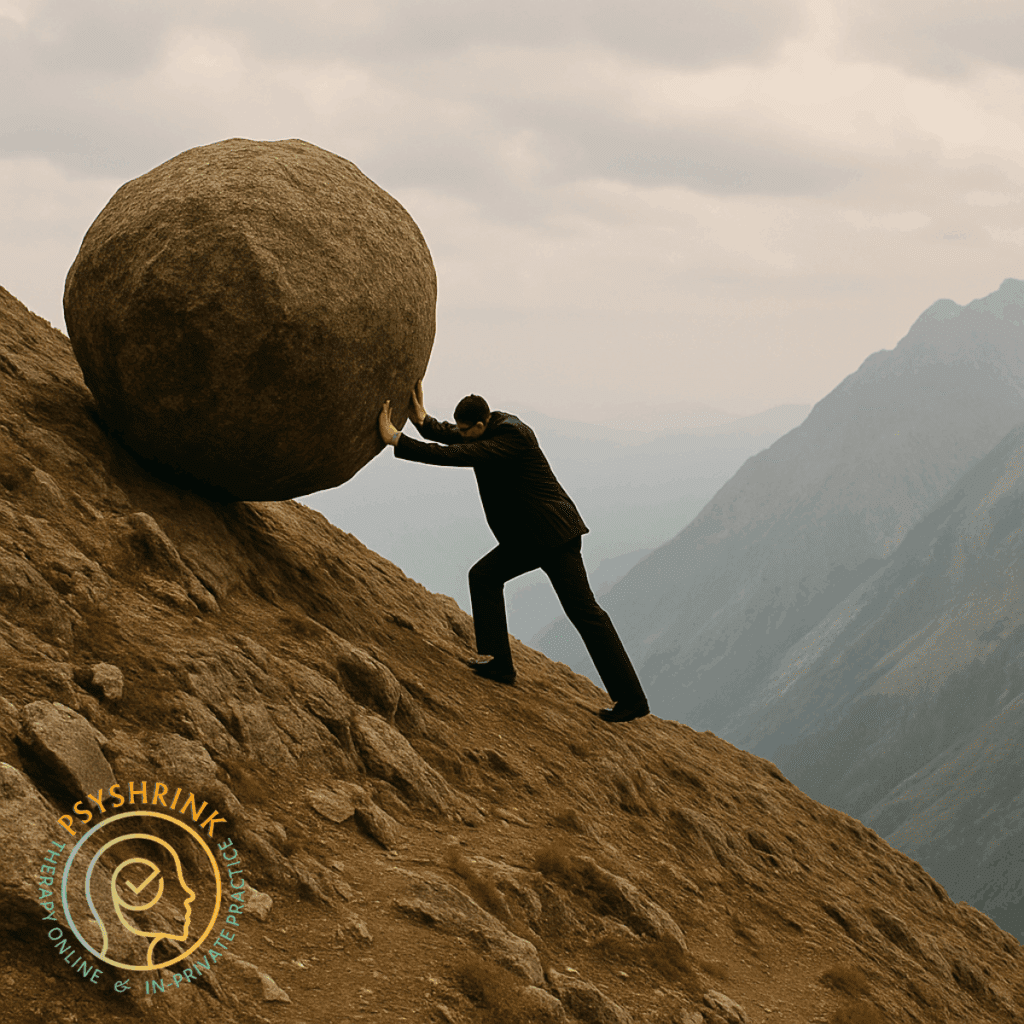
We love to tell exhausted people to “try harder,” “be more disciplined,” or “just push through.” But here’s the truth no one says out loud:
Burnout isn’t a motivation problem. It’s a physics problem.
There comes a point where the weight you’re carrying and the angle of the hill you’re climbing equal more force than one human nervous system can continue to generate. And no amount of “willpower” can change the laws of gravity.
Burnout happens when effort is constant and relief is rare.
When you imagine someone pushing a boulder uphill, it’s easy to focus on the person. But the slope matters. The environment matters. The expectations matter.
Most high-performing people don’t burn out because they’re weak.
They burn out because they stay strong for too long without support.
Burnout isn’t failure. It’s information.
Your body is not betraying you.
Your mind is not giving up.
Your system is giving you data:
“I can’t keep pushing like this.”
“Something has to change.”
“Rest is not optional anymore.”
Burnout is not a character flaw. It’s your biology saying ENOUGH.
We often think, “Other people handle this. Why can’t I?”
Because you’re not seeing the full picture.
Some people have more support.
Some carry fewer invisible responsibilities.
Some are allowed to rest.
Some don’t feel guilty setting boundaries.
Some aren’t in constant survival mode.
It’s not about strength.
It’s about load, leverage, and recovery.
Even professional athletes don’t train non-stop. Yet professionals, parents, leaders, and caregivers expect themselves to.
Burnout is what happens when your nervous system runs out of options—emotionally, physically, and cognitively.
When “pushing the boulder” becomes your identity, stopping feels dangerous. But continuing is even more dangerous.
Burnout can be reversed, but not by doing more.
The solution isn’t simply “work-life balance.”
It’s redistributing energy, responsibility, and pressure.
It looks like:
- Asking for help without shame
- Saying “no” without over-explaining
- Creating systems instead of relying on willpower
- Processing stress instead of storing it in your body
- Finding safety so your nervous system can finally exhale
And this is where therapy comes in.
Therapy isn’t “talking about your feelings.”
It’s learning how to:
- Reduce the slope of the hill
- Share the weight of the boulder
- Restore your energy
- Build a life you don’t need to escape from
Therapy is not weakness. It’s physics.
It’s how we change the equation.
You were never meant to push alone.
If every day feels uphill…
If you’re tired of being “the strong one”…
If the image of pushing a boulder feels like your life…
It’s not because you’re broken.
It’s because you’re human.
And humans are not designed to live in constant survival mode.
You deserve support before you collapse—not after.
Ready to feel human again?
I work with high-performing, high-caring people who are tired of pushing.
Let’s stop doing this the hard way.
You don’t need more strength.
You need a different strategy.
And I’m here when you’re ready.